Captions, stories, and calls to action
Small group questions from a sermon: how to write six to eight good ones
How to write six to eight small group questions from a sermon, in three kinds (observe, interpret, apply), with eight worked examples from a fictional sermon on Luke 10 and a check for weak questions.

Write six to eight questions in three kinds, in this order: two or three that ask what the passage says (observe), two or three that ask what it means (interpret), and two or three that ask what to do about it (apply). Make each one open, so it cannot be answered with yes or no, and tie it to a verse or something the pastor said. Then cut any question that your group would answer in one word.
This guide explains the three kinds, gives eight worked questions from a fictional sermon, and ends with a check you can run on any question. Where a number is a rule of thumb or our own suggestion, it says so. It was last checked on 16 October 2026.
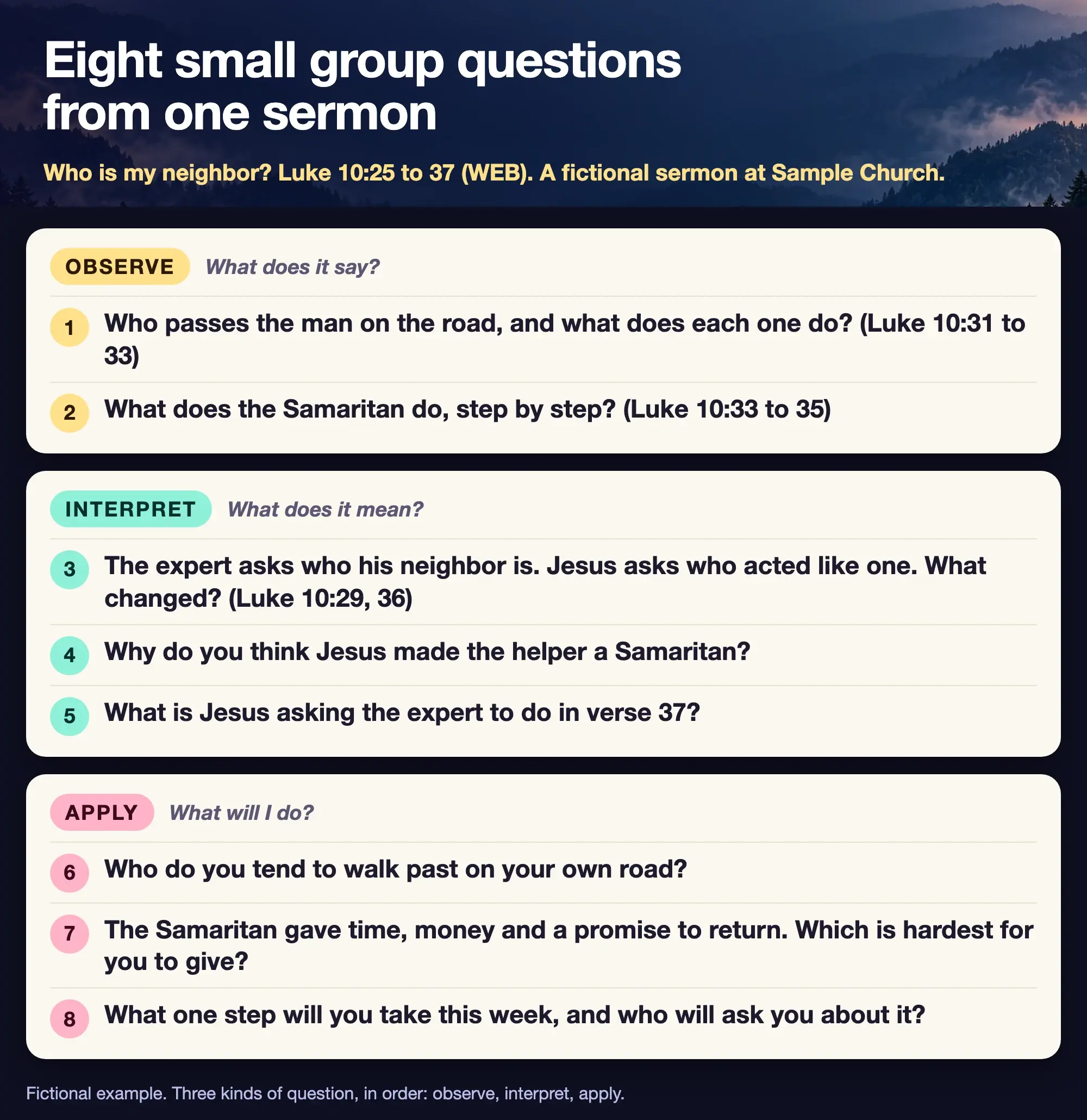
Fictional example from a sample church. The sermon is invented. The passage is Luke 10:25 to 37 in the World English Bible, which is in the public domain. The questions are repeated in the next section.
What makes a good small group question?
It is open, it points to the text, and it asks for one thing. Three sources agree on the first point. Chris Surratt, writing for Crosswalk on 22 July 2019 in Two Simple Secrets to Leading Small Groups Effectively, read on 16 October 2026, advises that a question calling for yes, no or another one-word answer should be rephrased or skipped, and that a follow-up "why" can open it up. The same piece says leaders do not need to ask every question, and puts it this way: "There are no prizes for finishing every question."
The second point comes from the shape of the sermon. Questions that name a verse or a line from the message send people back to the text, so the discussion stays on what was preached and not on the leader's opinion. The third point is plain: a question with two parts, such as "What does this mean, and how does it make you feel?", gets half an answer.
What are the three kinds of question?
Observation, interpretation and application. Nancy DeMoss Wolgemuth of Revive Our Hearts sums up inductive Bible study as three questions, read on 16 October 2026 (the page shows no publication date): what does it say, what does it mean, and what should I do. The same article moves from "what" to "So what?" and gives concrete responses, such as confessing sin, forgiving someone or giving to meet another person's need.
| Kind | Asks | Looks like |
|---|---|---|
| Observe | What does it say? | Who, what, where, in what order. The answer is in the text. |
| Interpret | What does it mean? | Why, what changed, what is the point. The answer needs thought. |
| Apply | What will I do? | Specific and personal. The answer is a step. |
The order matters. Start with the text so everyone is standing on the same ground, then move to meaning, then to life. A group that jumps to application on the first question tends to trade opinions.
What are some sermon discussion questions to copy?
Here are eight, from a fictional sermon called "Who is my neighbor?" on Luke 10:25 to 37 (World English Bible). Change the passage references and the details to your own sermon.
Observe
- Who passes the man on the road, and what does each one do? (Luke 10:31 to 33)
- What does the Samaritan do, step by step? (Luke 10:33 to 35)
Interpret
- The expert asks who his neighbor is. Jesus asks who acted like one. What changed? (Luke 10:29, 36)
- Why do you think Jesus made the helper a Samaritan?
- What is Jesus asking the expert to do in verse 37?
Apply
- Who do you tend to walk past on your own road?
- The Samaritan gave time, money and a promise to return. Which is hardest for you to give?
- What one step will you take this week, and who will ask you about it?
Notice what each one does. Question 1 can be answered from the text, so no one is put on the spot. Question 3 sets two verses side by side. Question 7 turns a detail from the passage into a choice with three answers. Question 8 asks for one step and a person, which makes the application specific.
How many questions should a group get?
Six to eight, and leaders pick which to use. This is our suggestion. A group that meets for an hour usually has time to dig into three or four, so a longer list gives the leader a choice without making them feel they must cover everything. Surratt's advice supports that: some questions deserve more time, and others can be skipped.
If a group of mixed experience meets, put one easy observation question first so everyone can answer.
How do you write them from a sermon?
Start from the message, not from a blank page. Four steps work.
- Get the outline and the passage. A transcript or a set of notes will do. Mark the big idea and the three or four points.
- Write one observation question per scene or point. Ask who, what and in what order. Add the verse reference so people can find it.
- Turn each point into an interpretation question. Ask why it matters, what changed or what the writer is saying. Keep the pastor's wording where you can, so the question matches the message.
- End with application, and make it specific. Pick the one step the sermon called for. Ask for a person, a time or a thing, not a general intention.
Then read each question aloud and ask whether you could answer it with one word. If you can, rewrite it or drop it. Ask a second person, ideally a group leader, to read the list before the groups see it. A simple content handoff shows a way to organize who reviews what, and repurposing one sermon without losing its point covers keeping a short version faithful to the long one.
Can a tool write the questions for you?
It can write a first draft. Sermon Uploads writes 6 to 8 discussion questions and a small group guide from the transcript of your sermon video, typically in about 15 minutes. The guide has a title, 3 to 5 key takeaways, 6 to 8 questions, one application and a closing prayer. They are drafts for a pastor or group leader to review and change, and you copy them into your own handout, email or group chat. The guide does not quote Bible verse text, and it names a reference only when the pastor said it in the sermon. See the small group questions page for what the output looks like.
Start with one sermon
Prepare clips and post text for your church to review.
Your first Sermon Uploads video is free with a free account, no card needed. Plans start at US$29.95 a month.
If you want a one-page handout for the room, the builder below makes a sermon notes sheet with a title, Scripture, the big idea, three points, a step for the week, a prayer line and three discussion questions. Pick your best three from the list above.
Sermon notes builder
Fill in the blanks, pick the words to hide, then copy or print a one-page sermon notes sheet.
Sermon notes
Peace That Guards
Philippians 4:6–7 (World English Bible)
“In nothing be anxious, but in everything, by prayer and petition with thanksgiving, let your requests be made known to God. And the peace of God, which surpasses all understanding, will guard your hearts and your thoughts in Christ Jesus.”
Big idea
When we bring our worries to God in , his guards our hearts and minds.
Point 1: Paul says “in be anxious,” but “in ” bring it to God by prayer.
Point 2: Our requests come with .
Point 3: God’s peace will our hearts and thoughts.
This week I will
Bring this worry to God by name:
Prayer
Lord, I bring you . Thank you for your peace. Amen.
Talk about it
- 1. Where do you notice worry first: in your thoughts, your body or your plans?
- 2. What changes when you add thanks to a hard prayer?
- 3. Who could pray with you this week?
Notes and questions online: example.church/notes
6 blanks on the page. About six, all the same length.
Plain-text version
# Peace That Guards

## Scripture
Philippians 4:6–7 (World English Bible)
“In nothing be anxious, but in everything, by prayer and petition with thanksgiving, let your requests be made known to God. And the peace of God, which surpasses all understanding, will guard your hearts and your thoughts in Christ Jesus.”

## Big idea
When we bring our worries to God in __________, his __________ guards our hearts and minds.

## Point 1
Paul says “in __________ be anxious,” but “in __________” bring it to God by prayer.

## Point 2
Our requests come with __________.

## Point 3
God’s peace will __________ our hearts and thoughts.

## This week I will
Bring this worry to God by name: ____________________

## Prayer
Lord, I bring you __________. Thank you for your peace. Amen.

## Talk about it
1. Where do you notice worry first: in your thoughts, your body or your plans?
2. What changes when you add thanks to a hard prayer?
3. Who could pray with you this week?

## Next steps
Notes and questions online: example.church/notes
Open the sermon notes builder on its own page. For more on planning a series, see sermon series ideas.
Before the questions go to the groups
- Are there six to eight, in the order observe, interpret, apply?
- Can each one be answered with more than one word?
- Does each observation question point to a verse or a line from the message?
- Does each one ask for one thing?
- Is the last question a specific step, not a general intention?
- Has someone other than the writer read them?
- Does the leader know they can skip questions?