Sermon repurposing and source integrity
How to repurpose one sermon without losing its point
A context-first method for turning one sermon into useful social posts while keeping quotes, paraphrases, and applications faithful to the source.
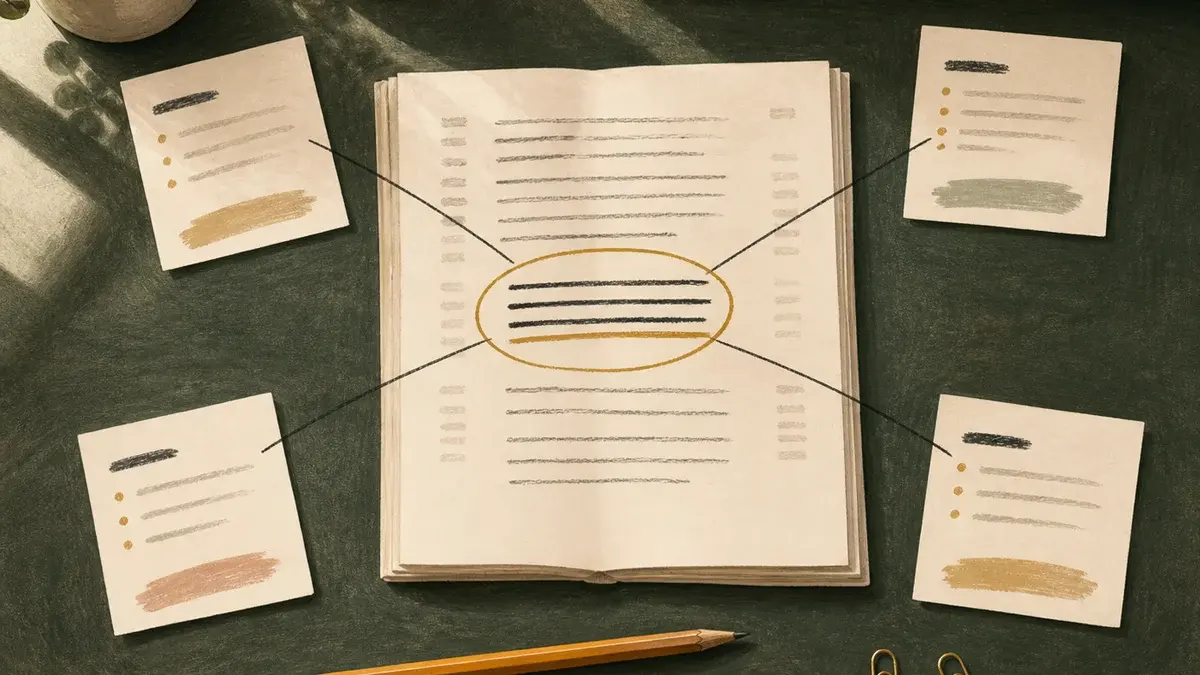
Map the sermon's argument before you pull a quote, write a caption, or choose a design. Then give each proposed post one clear job and link it to a specific source passage.
If a post needs missing context to remain true, add that context or drop the post.
The order matters. Many current church-content guides begin with clips, graphics, captions, and carousels. Those formats can be useful, but a format cannot protect meaning. A polished quote card can still misstate a sermon.
A transcript, an AI suggestion, or a strong visual can speed up the first draft. None can decide what the preacher meant or whether a short passage fairly represents the full message. The church communicator makes that call.
What does it mean to preserve a sermon's point?
A sermon is an argument, not a bag of quotable sentences. It may begin with a problem, interpret a passage, answer an objection, and end with an application. A sentence near the beginning can mean something different after the preacher qualifies it ten minutes later.
Preserving the point means that a reasonable person who sees the post alone would understand the same claim the sermon makes at that moment. The post does not need to reproduce the whole message. It does need enough context to stay accurate.
Use this four-part source map before selecting any posts:
- Write the sermon's central claim in one sentence.
- List the main moves that support, qualify, or apply that claim.
- Record where each move begins and ends in the video or transcript.
- Note the sermon's landing. What does the preacher ask listeners to believe, consider, or do?
Do not write this map from memory if a recording or transcript is available. Memory keeps the striking line and often drops the qualification.
How do you find post ideas without flattening the message?
Choose communication jobs before formats. A useful set might include one exact quote, one plain-language paraphrase of the main idea, a short teaching sequence, and one reflection question. It might include only two of those. The source decides.
For every candidate, record four things:
- Job. Is this post quoting, explaining, inviting reflection, guiding prayer, or recapping?
- Source span. Which timestamp or transcript passage supports it?
- Context debt. What would a reader need to know for this to make sense?
- Approval owner. Who can judge the source, pastoral fit, and permission to publish?
Context debt is the useful test. A candidate has low context debt when it expresses a complete thought and the surrounding sermon does not reverse or narrow it.
It has high context debt when it relies on a story the reader has not heard, a pronoun with no clear subject, a theological distinction made elsewhere, or a conclusion that arrives only after several earlier steps.
High context debt does not always kill a post. Sometimes the caption can supply the missing sentence. If the repair turns a short post into a miniature sermon, use a recap or link to the full message instead.
Current repurposing guides correctly point to several possible formats, including short clips, written reflections, graphics, and carousels. See the Church of England's current list of repurposing ideas and FaithMark's weekly content guide.
The harder editorial work comes first: deciding which idea can stand alone without changing the source.
Is this an exact quote or a paraphrase?
Call copy an exact quote only when the published words match the recording. Do not smooth the grammar, swap words, or join distant sentences and keep quotation marks around the result.
This is stricter than ordinary marketing copy for a reason. Reuters tells its journalists not to alter quotations in ways that change their sense and warns that selective quotation can be unbalanced. The Associated Press applies the same principle to edited audio and video.
These are newsroom standards, not church law, but the integrity test travels well. Read the Reuters quotation standard and the AP audio and video standard.
A paraphrase restates the idea in new words. Remove quotation marks and make the attribution clear in the caption. A summary compresses a larger section. Original application copy takes a source-grounded idea and invites a response. These are different editorial acts, so label them differently in your working notes.
Here is a fictional example. It does not come from a real sermon or church.
Exact source line: "Grace tells the truth about our failure without making failure our name."
An exact quote graphic must keep those words. A paraphrase could say that grace names what went wrong without reducing a person to it. A reflection question could ask what changes when failure is treated as an event rather than an identity. The latter two should not appear in quotation marks or under the preacher's name as spoken words.
If you work from YouTube captions, check any exact quote against the recording. YouTube says automatic captions can misrepresent speech because of pronunciation, accents, dialects, or background noise. YouTube's caption guidance tells creators to review and correct automatic captions.
Pay special attention to names, negation, numbers, Scripture references, and similar-sounding theological terms. A missing "not" can reverse a claim. A wrong chapter number can send a reader to a different passage.
What should the source checkpoint catch?
Stop before design and compare each candidate with its full source span. Ask:
- Does the post make the same claim as the source?
- Did the preacher qualify, correct, or complicate it nearby?
- Is an illustration being presented as a factual account?
- Is a personal story safe and permitted to repeat?
- Does a Scripture reference match the passage actually used?
- Can a reader understand every pronoun and implied subject?
- Does the caption add a promise, outcome, event detail, or pastoral claim that the sermon did not make?
Read one section before and after the selected passage. For a clip, watch those sections. For a quotation, listen to the words while reading the transcript. The transcript is a locator, not the final authority.
Keep the source span attached to the draft until approval. A bare design file is difficult to audit. A reviewer should be able to move from the post to the supporting moment without searching through the entire service.
When should you drop a potential post?
Drop it when repair would require you to write a new message on the preacher's behalf.
That includes candidates where:
- the memorable line depends on a setup the post cannot carry;
- shortening removes a condition, exception, or contrast;
- the sermon later corrects the first wording;
- the transcript is uncertain and the recording does not settle it;
- a testimony, counseling story, prayer request, or image lacks clear permission;
- the post would expose a child or vulnerable person;
- the application sounds like a guarantee;
- the only reason to keep it is that the weekly plan has an empty slot;
- several drafts repeat the same claim in different designs.
Publishing fewer posts is not a failed repurposing session. The win is a small set the church can defend, review, and use. Current practitioner discussions show why this matters. Church communicators still describe AI-assisted clipping as real work, and some explicitly recommend doing less rather than feeding every channel. That is anecdotal evidence, not a universal rule, but it matches the operational reality of review. See the recent r/churchtech discussion.
What does the final review need to decide?
The final reviewer is not checking spelling alone. They are deciding whether the post is faithful, suitable, permitted, readable, and ready for the chosen destination.
Use a short approval record:
- source span checked against the recording;
- quote mode confirmed as exact, paraphrase, summary, or original application;
- Scripture reference and names checked;
- sensitive material and permissions checked;
- visual text read on a phone-sized preview;
- caption and image alternative text reviewed;
- destination and timing confirmed;
- approver and date recorded.
For an informative graphic, alternative text should convey the essential information rather than repeat "image of." W3C's images accessibility tutorial also advises against putting important text only inside an image. Put the post's core idea in the caption when practical, and write alt text for what the image contributes.
When a reviewer changes the post's claim, return to the source checkpoint. A copy edit can become a meaning edit without anyone noticing.
Where does Church Media Kit fit?
Church Media Kit starts with a public YouTube sermon link and an explicit confirmation that the user has the right to use it. When captions are available, the current workflow uses bounded sermon evidence to create reviewable static post drafts. It records whether generated copy is an exact quote, paraphrase, or neither, and keeps transcript evidence with the draft.
Those controls reduce the time spent finding and organizing candidates. They do not determine theology, pastoral suitability, consent, or whether a short selection fairly represents the sermon. The church still chooses the content mix, checks the source, edits the copy, and approves publication.
That is the workable division of labor. Let software shorten the search. Keep interpretation and approval with the people responsible for the message.
A compact context-first sequence
If you need the whole method on one screen, use this order:
- Map the sermon's central claim, supporting moves, and landing.
- Choose a few communication jobs, not a quota of formats.
- Attach a source span and quotation mode to every candidate.
- Pay the candidate's context debt with a caption, a larger format, or a link.
- Drop any candidate that changes meaning, lacks permission, or cannot stand alone.
- Review the recording, source, visual, caption, alt text, destination, and approval owner.
The point of repurposing is not to make one sermon look like many messages. It is to carry the same message into smaller, useful encounters without pretending the smaller piece is complete on its own.