Volunteers, pastors, and operational handoffs
Church microphones: headset, lavalier or handheld for pastors and worship
Headset, lavalier or handheld for a church? A plain choice by role: the preacher who moves, the reader, the singer and the panel, with the feedback fixes that go with each.


On this page
- What is the difference between the three?
- Which is best for the preacher who moves?
- When is a lavalier the better choice?
- When is a handheld the better choice?
- What goes wrong with each, and what is the fix?
- What should be done about feedback?
- Skippable: what do polar patterns and omni mean?
- Which mic goes with which role?
- When is another approach better?
- Frequently asked questions
Say the pastor walks off the platform halfway through the sermon, turns to the screen, and every third sentence either vanishes or howls through the speakers. Nobody is to blame. The microphone was simply the wrong shape for how this person preaches.
The short answer: a headset for anyone who moves a lot or turns their head, a lavalier for a speaker who stays put and wants nothing on their face, and a handheld for singing, for passing around, and for guests. Ten-minute win: ask the pastor to walk and preach for two minutes while you watch the meter. If the level jumps every time the head turns, move to a headset.
What is the difference between the three?
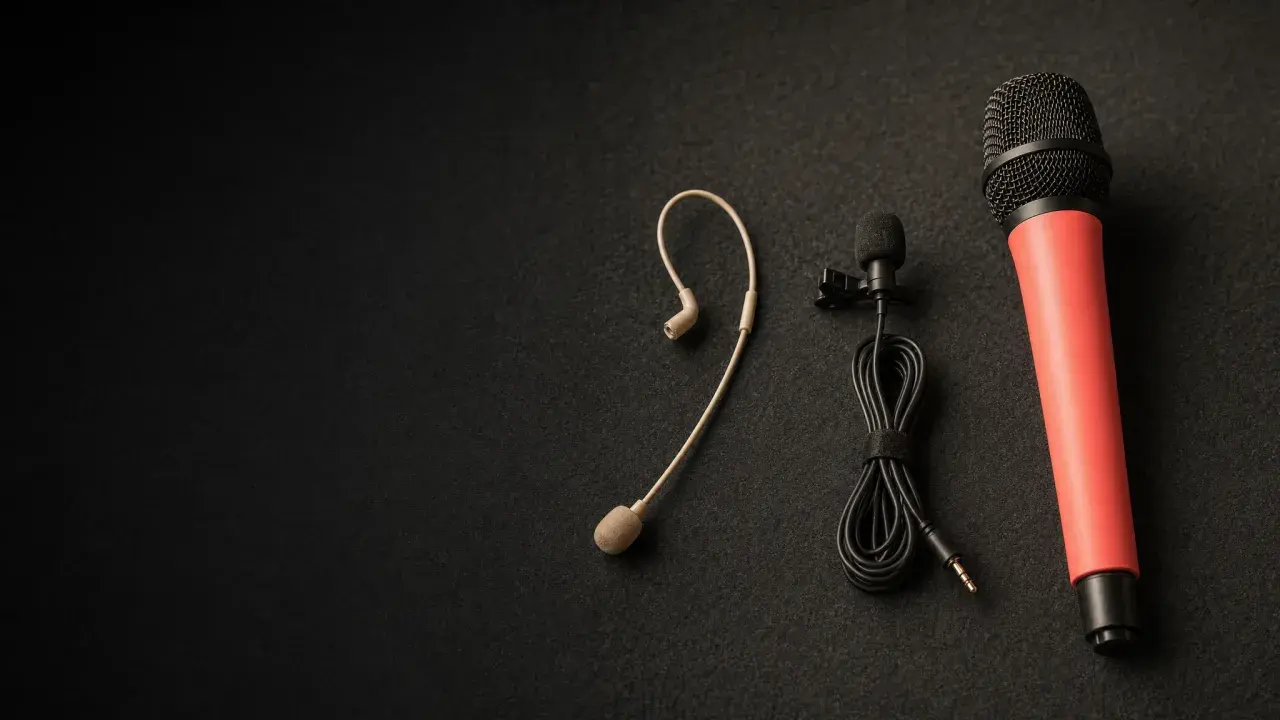
A headset (also called headworn) sits on a thin boom near the corner of the mouth. A lavalier (lav, lapel mic) is a tiny capsule clipped to clothing, usually on the chest. A handheld is the mic you hold. The first two plug into a small transmitter worn on a belt (a bodypack), and a wireless handheld has the transmitter built in.
What matters is distance from the mouth. A headset keeps a steady distance. A lav is farther away and does not follow the head. A handheld depends on the person holding it.
Free printable PDF
Sermon recording checklist
What is inside
- Choosing the sound source: the preacher's mic, the sound board or a separate recorder, with the source for each
- A mic, room and levels check, a test recording and a backup recording for one volunteer or a team
- File format, naming, a second copy and the hand-off to whoever posts, plus a notice for the congregation and guest speakers
- Variants for a phone, a board and cameras, a homily, an audio-only church and several campuses, plus a setup card and a weekly log
Enter your email and confirm a code to download. We email you a copy the first time each day.
Which is best for the preacher who moves?
A headset, in nearly every source we read. Shure's guide to choosing a pastor's microphone, dated 10 September 2021 and checked on 9 November 2026, calls the headworn mic "by far the most popular choice for preachers today" and says its fixed distance gives stable volume.
DPA's article on miking speech on stage, by Bo Brinck (no date shown, checked on 9 November 2026), says a lavalier "can cause severe level changes when the speaker turns his head." It presents the headworn mic as the main fix. It also says that because a headset sits so close to the mouth, it needs less gain, which helps when many mics are open at once. Gain here is how much the system amplifies the mic. Less gain is more room before feedback.
When is a lavalier the better choice?
When the person speaks from one spot and does not want something on their face. Church Production Magazine's "Handheld, Lavalier, or Headset?" by Chris Huff (no date shown, checked on 9 November 2026) gives the two sides: one pastor who preaches from a pulpit is happy with a lav, while another who walks the sanctuary needs a headset. The article's own point is that the speaker's preference matters.
Lavs are simple to put on anyone, so they suit rotating readers and guests. They are less forgiving about placement. Shure's pastor guide says to keep placement the same each week because movement shifts it, and to keep it clear of layers of clothing or anything that rubs. Sennheiser's how-to on headworn and lavalier microphones warns about sleeves and clothing brushing the mic, and says a lav taken off the shirt and held like a handheld sounds worse because the distance to the mouth is no longer right.
When is a handheld the better choice?
For singing, for passing around the room, and for guests who will not wear anything. Shure's guide says a handheld lets the speaker control volume by moving it nearer or farther, and notes the cost: it occupies a hand, which limits gestures. The Church Production article says the biggest problem is relying on the speaker to hold it right, with presenters who start with the mic at the mouth and it "ends up by their navel," and suggests locking or taping the power switch on wireless units so it is not turned off by accident.
What goes wrong with each, and what is the fix?
| Mic | Common problem | Fix |
|---|---|---|
| Headset | Glasses move the boom and rub; a new beard adds noise | Church Production reports one church fixing the glasses case with a small piece of clear medical tape on the face. For long hair or anyone who does not want a headset, Shure suggests an earworn model (its MX153) |
| Headset | Fitting each time for a new person is slow | Dedicate the headset to one person (Church Production) |
| Lavalier | Level drops when the head turns | Clip it as close to the mouth as practical, centred on the chest; or move to a headset |
| Lavalier | Rustle | Keep it clear of layers and hair; keep the clip tight |
| Handheld | Mic drifts away from the mouth | Brief the speaker once; consider a pulpit stand for set-piece moments |
| Any wireless | Mic is live while the person is still at the lectern mic | Mute the body mic at the lectern (Shure: both on gives a hollow sound and heavy feedback) |
What should be done about feedback?
Feedback is the howl when a mic hears the speakers and amplifies them in a loop. Shure's "How to Control Feedback in a Sound System" (published 25 January 2013, checked on 9 November 2026) gives the order of fixes. Keep loudspeakers away from microphones, because doubling the distance allows about 6 dB more output. Move the speakers closer to the audience, because halving that distance allows about 6 dB more. Turn off mics that are not in use. Do not cup a handheld grille. Avoid big EQ boosts.
To ring out a system, it says to raise the level until it starts to ring, cut that frequency by about 3 dB on a graphic EQ, and repeat, then stop before over-equalising. It adds that automatic feedback reducers can help. In our view they do not replace good placement.
For the room-side causes, see what to consider when choosing a church sound system and church echo and acoustics.
Skippable: what do polar patterns and omni mean?
Skip this if you only need the choice. Cardioid mics hear mostly in front and reject sound from the sides and rear, which helps feedback. Omni mics hear all around. DPA says omnidirectional headsets sound more natural and are less sensitive to exact position, while directional headsets reject more room and stage sound. The Church Production article suggests cardioid designs for pastors who hear themselves in monitors or work in difficult rooms.
Which mic goes with which role?
This table is our summary of the sources above. Treat it as a starting point and let the speaker try each.
| Role | First choice | Second choice | Watch for |
|---|---|---|---|
| Preacher who moves | Headset, dedicated to them | Earworn if long hair (Shure); tape for glasses (Church Production) | Mute at the lectern if there is a lectern mic |
| Preacher at a pulpit | Lavalier or lectern mic | Headset | Placement the same each week |
| Reader or announcer (several people) | Lavalier clipped to each | Handheld passed along | A quick placement check, as people change |
| Singer | Handheld | Headset if hands are needed | Power switch locked; distance to mouth |
| Panel or interview | Lavalier or headset each | Handheld for the host | Mute the mics of people not speaking |
| Guest speaker | Whatever they bring or prefer | Handheld | Ask in advance, and test during setup |
When is another approach better?
If the room is very reverberant, a better mic will not fix muddy speech. In our view the fix is the room and speaker placement first, and a mic upgrade second. If the pastor will not wear a headset, a lavalier that is placed the same way each week beats a headset worn badly.
Frequently asked questions
Are headset mics always best for pastors?
They are the most popular in the sources we read, and fit anyone who moves. A pastor who stays at the pulpit may prefer a lav, and that is fine.
Can several people share one headset?
It is possible, but Church Production notes that fitting it each time is slow and says headsets are best dedicated to one person. Shure praises its TH53 headset frame as easy to adjust when several speakers use one mic.
Why does the mic squeal only when the pastor walks to the front?
Likely the speakers are in front of the mic's pickup area. Shure's advice is to keep the mic away from the loudspeakers and move the speakers toward the audience.
Is wired or wireless better?
Church Production says wired handhelds suit churches that cannot afford wireless. Wireless gives freedom but adds batteries and a switch someone can knock.
Do I need an expensive mic?
Church Production mentions a bulky headset at under $30 that it would not use for services, and says thinner frames come at around $700. Price tells you little about fit, so let the speaker try one.
Free printable PDF
Sermon recording checklist
A printable checklist for recording the sermon or homily every week, from one volunteer with a phone to a team with a sound board and cameras: choose the sound source, place the mic, set levels, frame the preacher, run a backup recording, name and save the file, tell people it is being recorded, and hand the file on, with a setup card and a weekly log.
Enter your email and confirm a code to download. We email you a copy the first time each day.
Try Church Media Kit
Review what’s included and try the tools that fit your church’s workflow.
A free account needs no card. Sermon to Social, Sermon Clips and Sermon Slides each give one free use. That is one sermon, one upload up to 2 hours, and one AI presentation. Church in bio is free for 14 days after you first publish it. Design and Verse of the Day are free with any account. Review the offer when choosing your plan.